


Purpose
-
Assess risks to understand potential negative impacts during or after a transition.
-
Use this understanding to recommend actions.
Description
-
Risk Analysis and Management
-
Evaluate risks related to current state, future state, change, change strategy, or tasks.
-
Analyze:
-
Possible consequences
-
Impact
-
Likelihood
-
Time frame
-
-
-
Using Risk Collection
-
Input for change strategy.
-
Accept risk if modifying it is more costly than potential loss.
-
Managing Risks
-
Proceed with change while managing risks to minimize impact on value.
Important Note
-
Positive Risk
-
Opportunities are managed as needs.
-
Risk is for uncertain events with negative outcomes.
-

Inputs
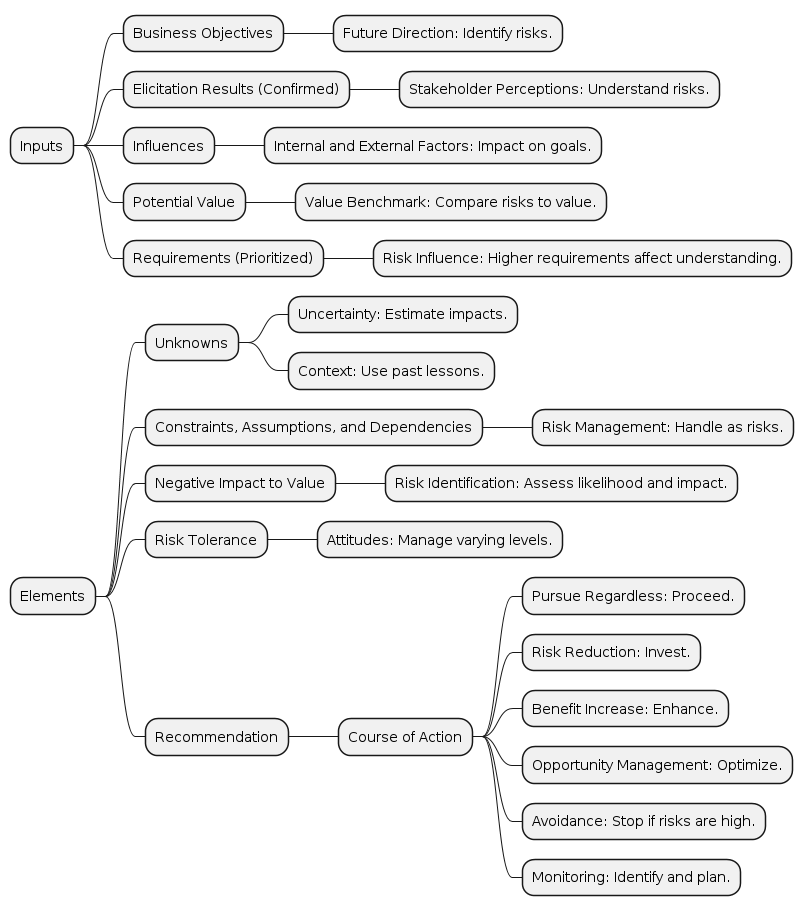
Business Objectives
-
Future Direction: Identify risks.
Elicitation Results (Confirmed)
-
Stakeholder Perceptions: Understand risks.
Influences
-
Internal and External Factors: Impact on goals.
Potential Value
-
Value Benchmark: Compare risks to value.
Requirements (Prioritized)
-
Risk Influence: Higher requirements affect understanding.
Elements
Unknowns
-
Uncertainty: Estimate impacts.
-
Context: Use past lessons.
Constraints, Assumptions, and Dependencies
-
Risk Management: Handle as risks.
Negative Impact to Value
-
Risk Identification: Assess likelihood and impact.
Risk Tolerance
-
Attitudes: Manage varying levels.
Recommendation
-
Course of Action:
-
Pursue Regardless: Proceed.
-
Risk Reduction: Invest.
-
Benefit Increase: Enhance.
-
Opportunity Management: Optimize.
-
Avoidance: Stop if risks are high.
-
Monitoring: Identify and plan.
-
Guidelines and Tools
-
Business Analysis Approach: Guides risk analysis.
-
Business Policies: Define decision-making limits.
-
Change Strategy: Plans transition and assesses risks.
-
Current State Description: Contextualizes present risks.
-
Future State Description: Identifies future risks.
-
Identified Risks: Starting point for assessment.
-
Stakeholder Engagement Approach: Identifies impact of forces.
Techniques
-
Brainstorming: Collaborative risk identification.
-
Business Cases: Capture change-related risks.
-
Decision Analysis: Assesses problems.
-
Document Analysis: Identifies risks in existing documents.
-
Financial Analysis: Understands financial risks.
-
Interviews: Gathers stakeholder insights.
-
Lessons Learned: Utilizes past issues as risk foundations.
-
Mind Mapping: Categorizes risks and relationships.
-
Risk Analysis and Management: Identifies and manages risks.
-
Root Cause Analysis: Addresses underlying problems.
-
Survey or Questionnaire: Gathers stakeholder perceptions.
-
Workshops: Engages stakeholders in risk assessment.

Stakeholders
-
Domain Subject Matter Expert: Provides input based on expertise.
-
Implementation Subject Matter Expert: Offers insights into preparation needs.
-
Operational Support: Identifies potential risks and impacts.
-
Project Manager: Manages and mitigates project risks.
-
Regulator: Ensures compliance with laws and regulations.
-
Sponsor: Authorizes and funds change, needing risk understanding.
-
Supplier: Risks may arise from utilizing external suppliers.
-
Tester: Identifies risks from a validation perspective.
Outputs
-
Risk Analysis Results: Understanding of risks and mitigation strategies.
